Deployment Arrangement
As the renovation was underway, resources had to be prepared at each stage to serve multiple types of equipment during the multiple stages of construction. The Owner requested their data analytics software to be utilized in testing the old heating hot water system in order to validate and verify the building needs were being met with the geothermal systems. They discovered that the old hot water heating systems did not provide enough hot water with the old pumps.
Synergy’s Commissioning Plan is simple. During building commissioning, Synergy works very closely with the owner, facility manager, and design-build project managers to establish benchmarks, create metrics, and follow trusted processes that empower the whole team to meet the desired objectives.
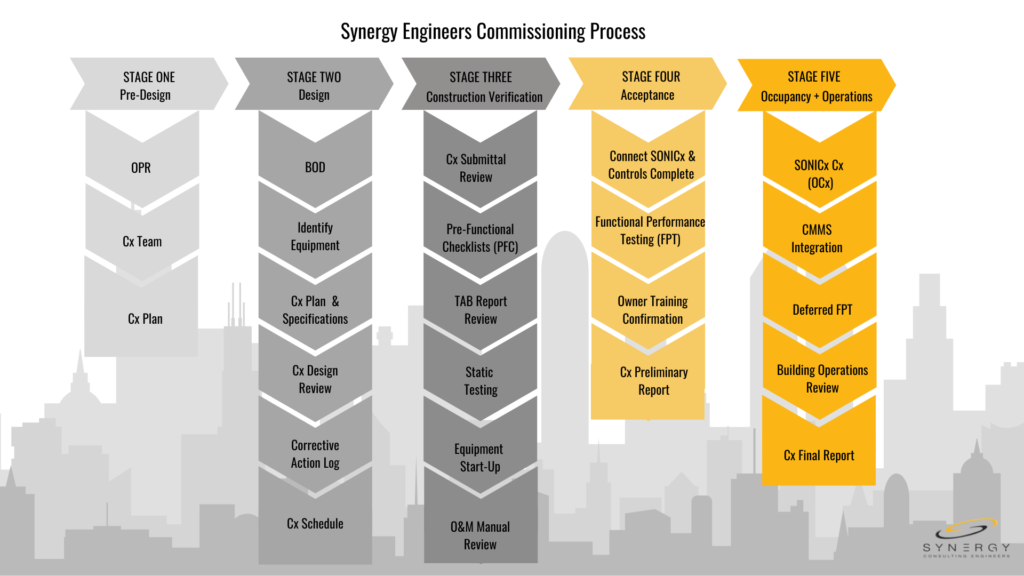
The Commissioning Process included testing the new geothermal pumps, water balancing and heating hot water testing to confirm the temperatures balanced out the comfort levels during the cold and hot seasons. Synergy also made recommendations on balancing the flow rates because the geothermal pumps were vastly different than the old hot water heating system.
At completion, the owner received the much-needed upgrades in MEP improvements. This enabled the facility to operate the new equipment at a low/no cost due to the initiative.
Launching a building renovation initiative based on geothermal renewable energy was expensive with first costs but was projected with sustainable and life-cycle costs.
Lessons Learned
The Mechanical Contractors on this project thoroughly inspected all equipment assets and Synergy tested the sequence of operations. This ensured the equipment was tested in its entirety, from start up to shut down. For example, when the Synergy team tried to force the pumps to turn on and off, they discovered the pumps did not automatically reset, which was problematic. The facility team had to go back to the Building Automation System (BAS) and manually reset the boilers. Pointing this problem out early helped the operations make adjustments and implement automatic resets in the BAS.
Owner Success
A commissioning agent is often expected to give a stamp of approval that all MEP assets are fine. However, a good Cx agent will be the Owner’s Advocate by working through issues and making sure assets are actually running properly. During this project, Synergy’s Cx agent helped the owner work through several issues. One example was an issue with the geothermal water pumps that were not cycling properly. Out of the 3 pumps, only 2 should’ve been running at any given time. However, there were no redundancies in place, so all 3 pumps were running at the same time, all the time. Synergy’s team helped them work through the controls issues on the pumps so it operated effectively.
A thorough Cx process will uncover issues in a timely manner to allow facility teams to address and correct issues, otherwise left undone they can create more expensive and complicated issues later on. Out of the 412 issues discovered during design review, site inspections, and system testing, here are a few examples:
- The geothermal loop was installed in a location that would not control the temperature loop. This incorrect installation caused an alteration to the sequence of operations.
- The primary chilled water pumps were supposed to include a new trimmed-down impeller. This was missed during installation and the spec impellers were utilized instead. The pumps were exceeding their rated current draw, trying to achieve the proper flow, but couldn’t because of the incorrect impeller size.
- The chilled water return was short cycling through the bypass loop causing the chilled water supply to be too warm. The problem was creating dehumidification issues on humid days within the building. The issue was corrected by artificially speeding up the pumps in the primary loop. The increased supply water flow allowed the system to accurately track demand and temperatures.
Another valuable find were the issues discovered with the boilers that wouldn’t unload normally. Testing is traditionally performed with ramping up equipment, but backing down was not tested. When Synergy’s Cx agent discovered this, they pointed out the boilers were not cycling down the same way they cycled up. The boilers needed to be reprogrammed so they would operate correctly.
Launching a building renovation initiative based on geothermal renewable energy was expensive with first costs but was projected with sustainable and inexpensive life-cycle costs. Not many owners can demonstrate how they’ve made a building more comfortable and reduced energy usage, but the forward-thinking leaders of this project did just that. They revitalized a historic, drafty building and renovated it to a highly-functional, controlled environment for future generations to enjoy.
Historic Building Reverses Aging with Geothermal Renewable Energy